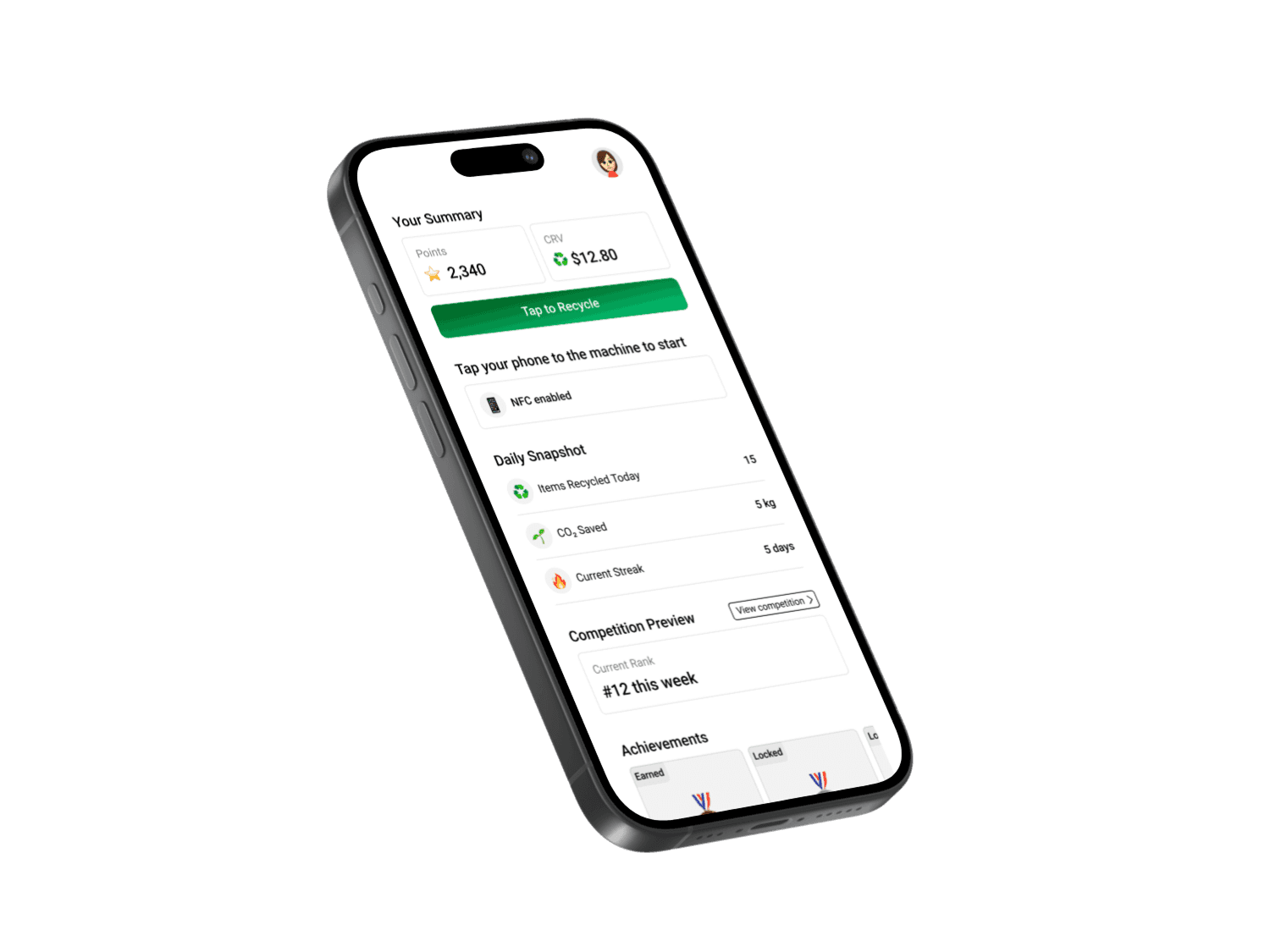
Recyclify: Gamifying Recycling
Research Synthesis, Behavior Design, UX Prototyping
October–December 2025
A 6-week feasibility project exploring how gamification and a Reverse Vending Machine (RVM) system could reduce waste contamination and increase recycling engagement at UC San Diego.

01 Overview
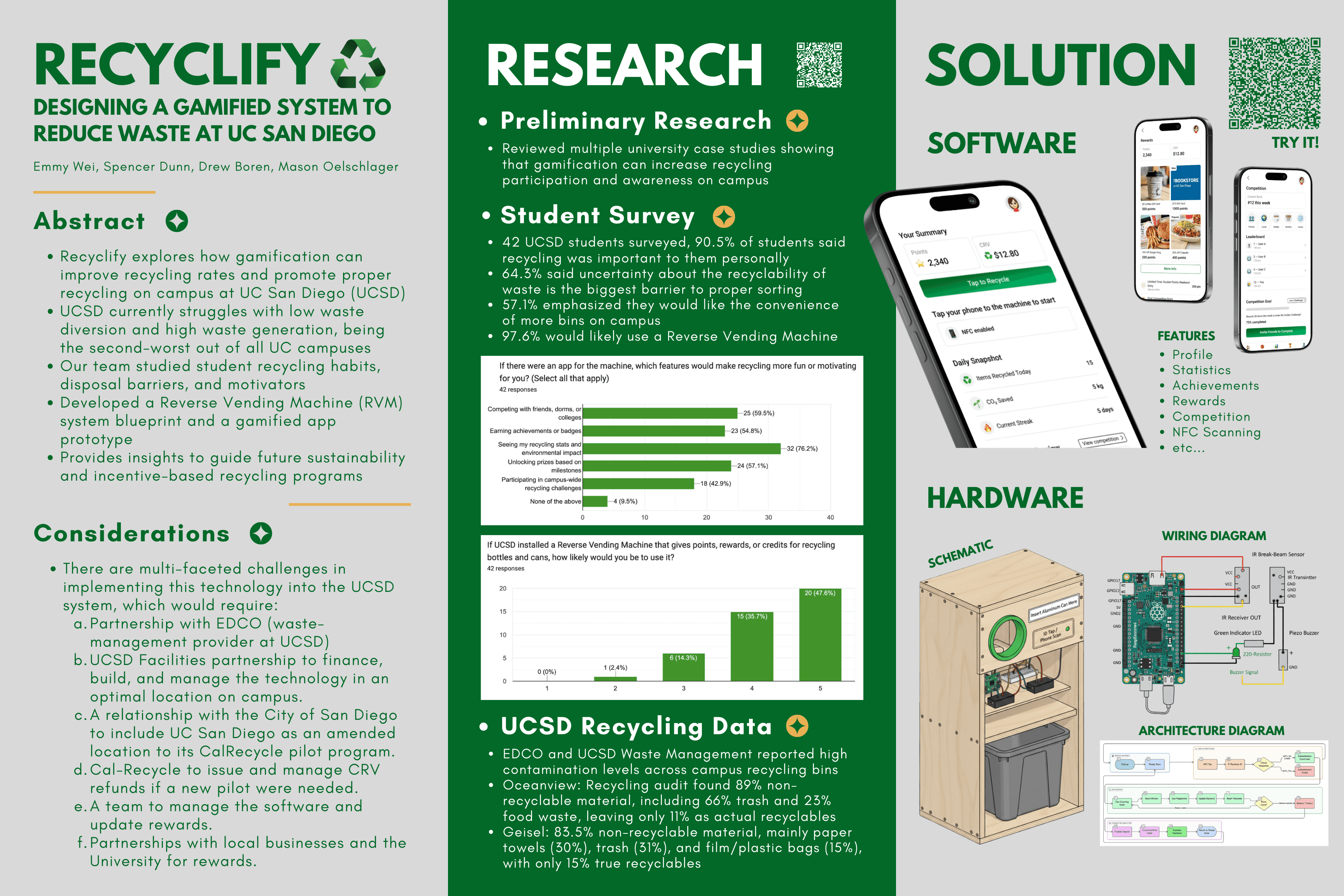
Recyclify investigates whether a gamified recycling system—combining a Reverse Vending Machine (RVM) and a companion mobile app—could meaningfully improve recycling behavior at UC San Diego. UCSD currently struggles with high contamination rates (80%+ in many bins), low awareness of what is recyclable, and unclear signage. Our team examined whether incentives, clearer guidance, and a feedback loop could shift student behavior.
My contribution centered on research synthesis, survey development, concept strategy, and designing the functional app prototype that demonstrated how rewards, competition, and personal recycling data could motivate sustainable action.
02 The Challenge
UC San Diego has one of the lowest diversion rates in the UC system. Across campus, recycling bins are heavily contaminated—often 80–90% non-recyclable material.
Students expressed that:
• They want to recycle but are unsure what is recyclable.
• Campus signage is inconsistent and confusing.
• Recycling tools feel passive, unengaging, and easy to ignore.
• They would participate more if recycling were “simpler, clearer, or rewarded.”
Facilities and EDCO confirmed these pain points: sorting confusion, lack of visibility, and no prior experimentation with RVM technology on campus.
Could a gamified system make proper recycling easier and more motivating — without overwhelming students or adding maintenance burden?
03 Goal
Create a feasible, data-backed concept for a gamified campus recycling program that:
Reduces contamination through clearer guidance and behavior reinforcement
Rewards students for sustainable actions
Uses feedback loops (data, achievements, competition) to sustain engagement
Demonstrates how an RVM + app system could work at UCSD
Provides actionable insights for Facilities Management and sustainability partners
04 Research Approach
1. Preliminary Literature Review
We examined university case studies demonstrating that gamification—points, achievements, rankings—can significantly increase proper recycling and waste sorting.
Key insight: Gamification works only when paired with clarity + convenience + immediate feedback.
2. Stakeholder Interviews (EDCO + UCSD Facilities)
We consulted with EDCO’s environmental team and UCSD Facilities contacts. They confirmed:
• Contamination is widespread and persistent
• Students mis-sort due to confusion, not apathy
• No RVM-based systems currently exist at UCSD
• A pilot could realistically be explored if supported by data
Both stakeholders validated that our findings matched their internal dashboards.
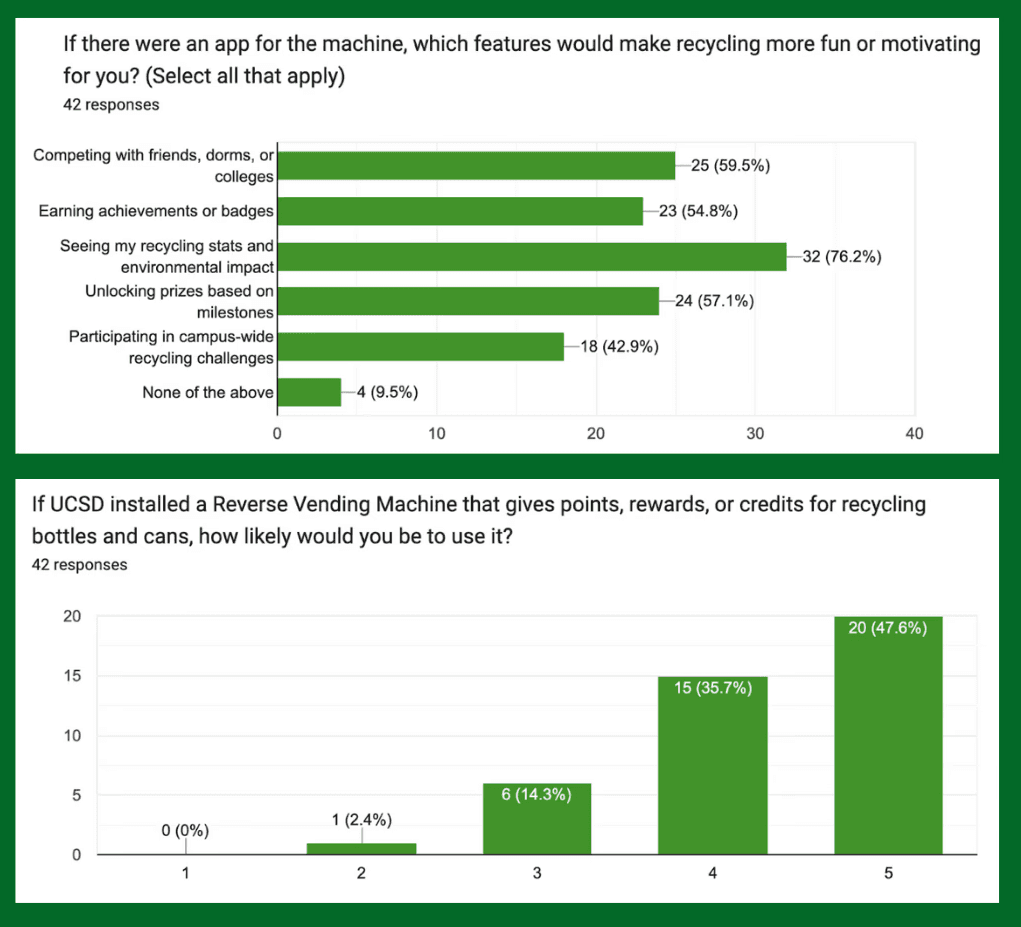
3. Student Survey (n = 42)
I co-designed the survey to understand recycling attitudes, knowledge gaps, and openness to a rewards system.
Findings:
• 90.5% say recycling is personally important
• 64.3% do not know what is actually recyclable
• 57.1% want more convenient bin placement
• 97.6% would use an RVM offering rewards or CRV return
• Students prefer simple interfaces with visible personal impact
These insights directly guided the app IA and feature prioritization.
05 Concept Development & Ideation
We explored three models:
Pure RVM system — convenient but lacks deeper engagement
Gamified app only — motivating but disconnected from real actions
Hybrid RVM + App ecosystem — immediate physical feedback + sustained digital engagement
We chose the hybrid model because it best supports real-world behavior change.
I focused on defining:
• How onboarding should clarify confusion about recyclable materials
• How incentives should feel rewarding but not gimmicky
• How data visualization could reinforce progress over time
• How leaderboards could support light campus-wide challenges without social pressure
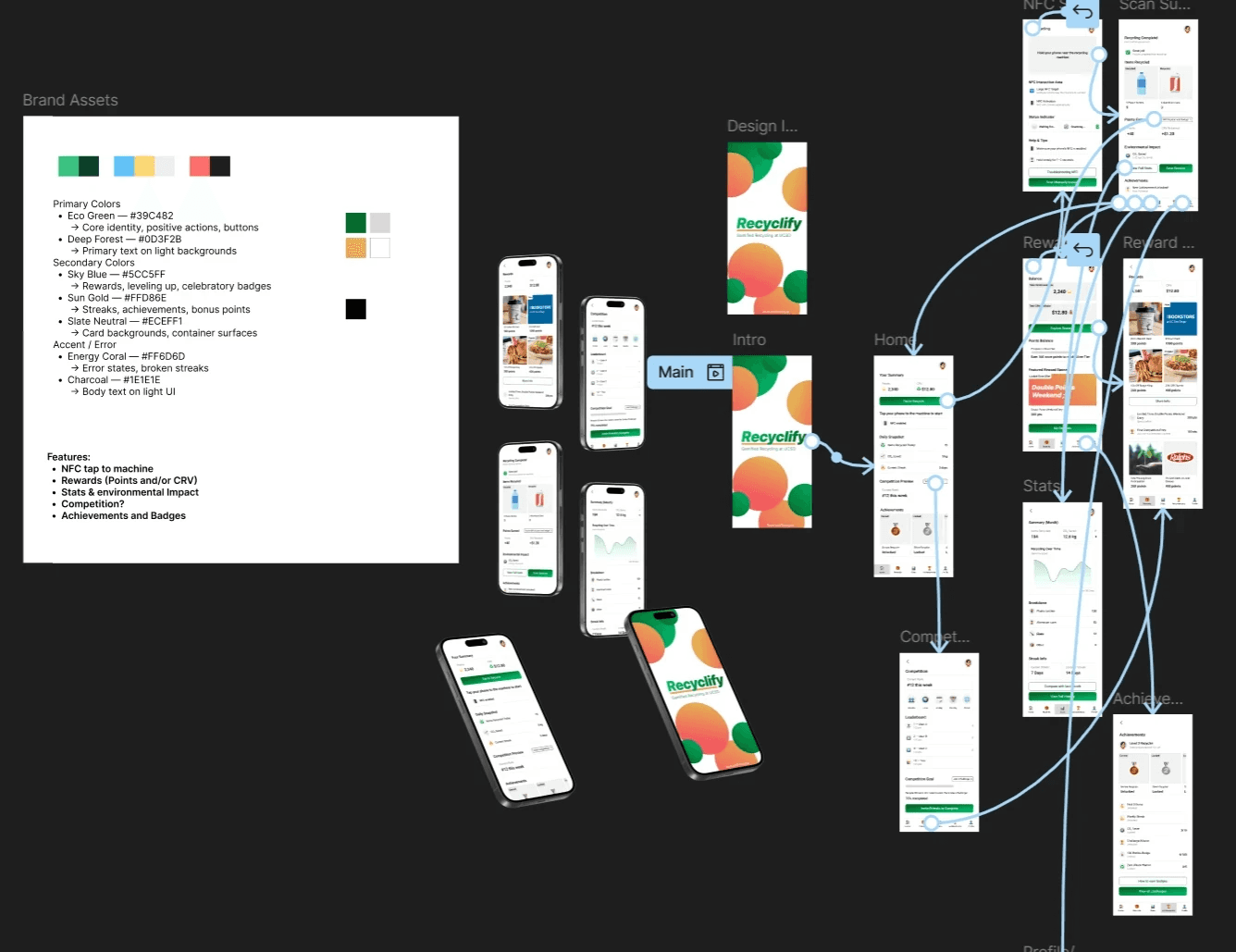
06 Prototyping (My Core Area)
I created the first functional (non-visual) prototype in Figma to validate:
• Onboarding clarity — Does the user understand what can/can’t be recycled on campus?
• Behavior triggers — Will rewards or achievements actually increase motivation?
• Data dashboard — What metrics matter to students?
• RVM interaction flow — How should NFC scanning or QR code confirmation work?
Note: I later polished up the graphics and added color to give it a more Hi-Fi feel for presentations.
Features included:
Profile
Baselines recycling goals and progress.
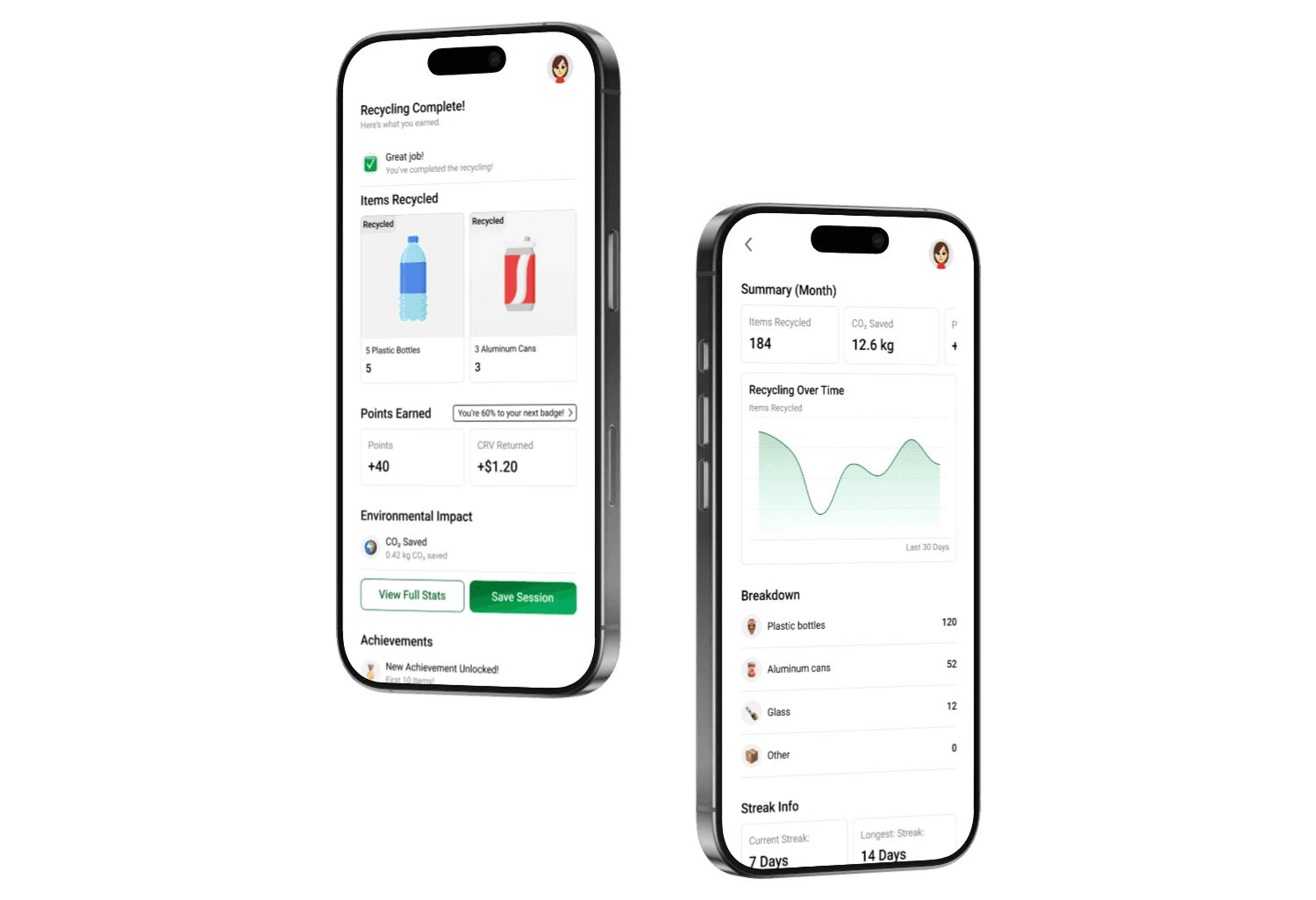
Recycling Snapshot
Daily and weekly statistics showing volume, contamination reductions, and CO2 impact.
Achievements
Streaks, challenges, and milestone badges that reinforce sustainable behavior.
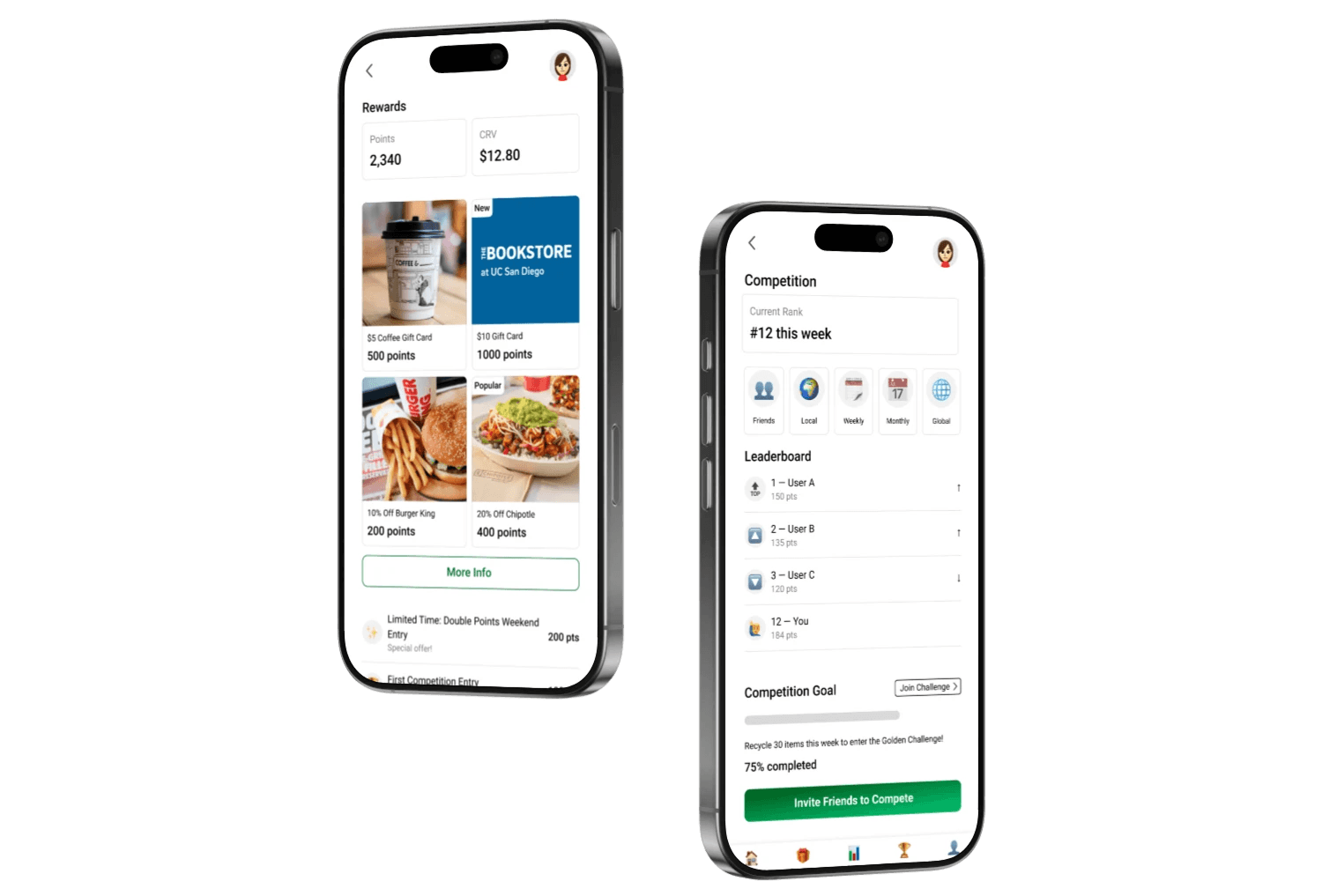
Competition
Optional leaderboards across colleges, teams, or friend groups.
Rewards
Redeemable points or CRV equivalents tied to RVM interactions.
This prototype helped us validate feasibility and communicate system vision to stakeholders.
07 Testing & Feedback
We presented Recyclify to two UCSD stakeholders:
Leo Acosta — Associate Director of Campus Dining
Cindy Penning — Leasing Administrator at Price Center
Their feedback:
• “Your data is spot-on with what we’re seeing internally.”
• “Facilities Management would likely be very interested in this direction.”
• “This is more innovative than anything we’ve tried on campus.”
Feedback reinforced that Recyclify addressed real needs and surfaced viable paths for further development.
08 Outcome
Our final feasibility package included:
• RVM hardware blueprint
• Functional app prototype
• Student survey insights
• Stakeholder validation
• UCSD contamination baseline report
• Deployment considerations
• Recommendations for UCSD Sustainability and Facilities
While full implementation would require external funding and cross-departmental partnership, Recyclify demonstrated that a gamified approach could realistically reduce contamination and increase recycling accuracy.
09 What I learned
This project strengthened my skills in:
• Research synthesis and survey design
• Translating environmental data into UX decisions
• Designing behavior-change systems
• Prototyping non-visual functional flows
• Presenting to campus stakeholders and aligning design to operational realities
I gained a deeper understanding of how product design intersects with systems, incentives, and physical-digital touchpoints—and how thoughtful UX can influence real-world sustainability practices.